


Welcome to Letters from Italy! the spot where Italian words, phrases and sayings are explained before they leave you puzzled, while nodding along as if you understood. Grab something warm because Autumn has already decided the first letter. And no, it’s not in alphabetical order…
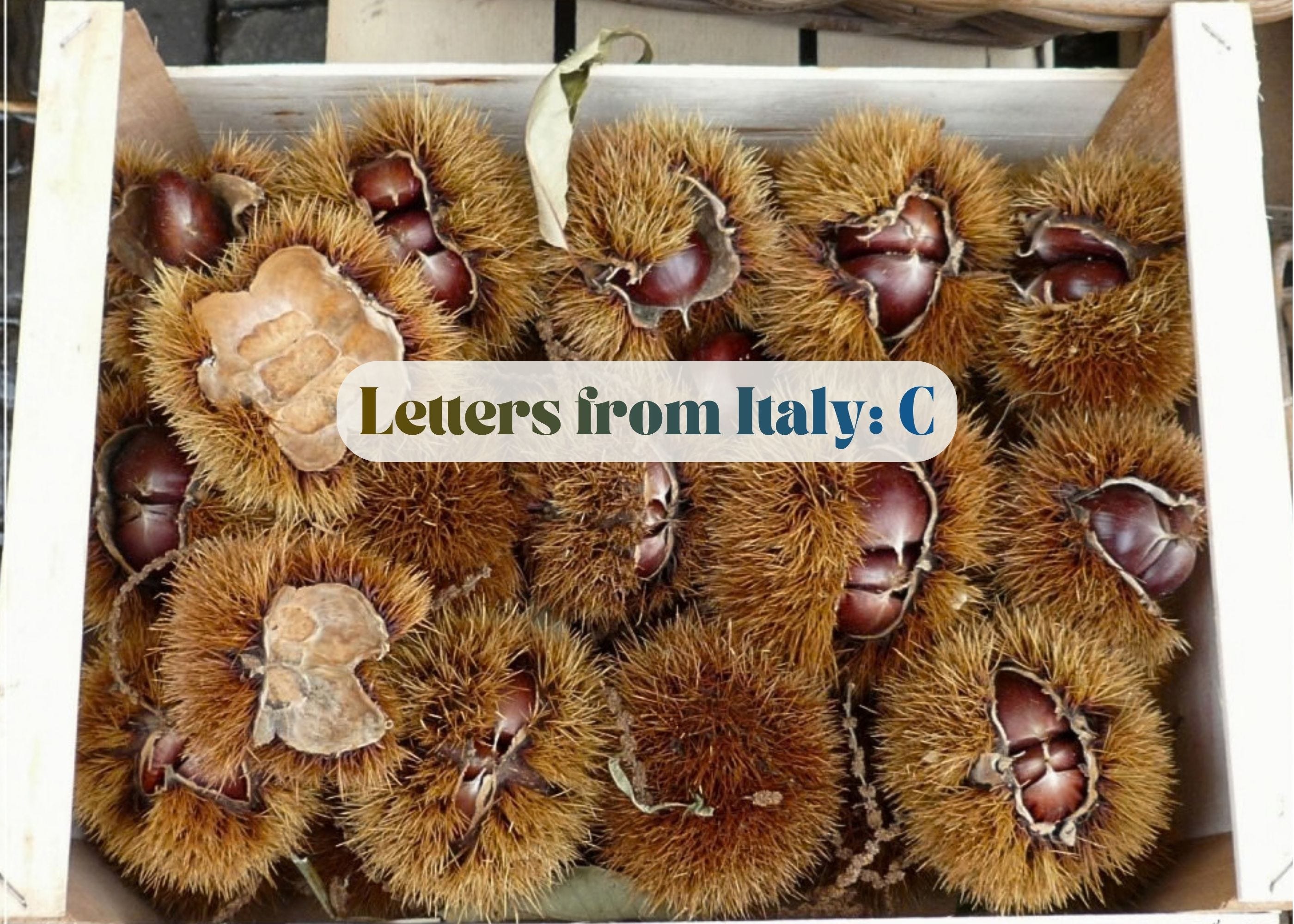
We realize it’s autumn when the chestnuts turn up on the market stalls and the smell of the roasted ones hits you before you’ve even decided to stop. Only then does the brain admit that shorts and flip-flops are over and Summer becomes a rumor. Even if our beautiful Roman “Ottobrate,” mean that warm days are still on. (To know more about Ottrobrate check the link at the end of the article).
The everyday word is “castagne” (chestnuts). And within castagne variation we have “marroni,” the selected, larger, rounder cultivar — same tree family, better manners, often easier to peel. Both may turn into “caldarroste” when roasted scorched on those seasoned perforated skillet: skin nicked, coals underneath.
In Rome you can buy a “cartoccio” (or “cuoppo” in Naples) from the street vendors around the city. It’s a paper cone that serves two purposes: one for measure, the second is for convenience, a practical way to eat caldarroste when walking and window shopping, while keeping your hands warm.
Say it in Italian:
castagna / castagne [kah-STAH-nyah / kah-STAH-nyeh];
marrone / marroni [mah-ROH-neh / mah-ROH-nee]
caldarrosta / caldarroste [kahl-dah-ROH-stah / kahl-dah-ROH-steh];
cartoccio [kar-TOH-choh];
cuoppo [KUOP-poh].
And here is when castagne and marroni wander off the fruit realm.
Castagne
“Che castagna!” Lit. What a chestnut! meaning what a punch in boxing, and what a kick in Italian football (soccer); a proper heavy shot of sort.
Then there’s “togliere le castagne dal fuoco (con la zampa del gatto)” — lit. pull the chestnuts out of the fire with the cat’s paw. You do the risky bit so someone else gets the reward. It tracks back to La Fontaine’s fable of the monkey and the cat: the monkey flatters, the cat singes its paws, the monkey eats. Same picture in French (tirer les marrons du feu) and a few other languages.
From the old times we have “(due) castagne secche” —lit. two dry chestnuts— for things lacking importance, lesser common nowadays. Chestnuts were once known as “the bread of the poor,” standing in when grain was scarce or too expensive. Because the dried ones were cheap and easily accessible, they became a reference for something of little value.
This concept survives in modern Italian idioms:
“Valere un fico secco” —lit. to be worth a dried fig— (still somehow fruity). And
“Non valere un soldo bucato” —lit. to not be worth a punched coin.
There’s also “mondare le castagne” —lit. to clean the chestnuts— doing a time-consuming futile job.
These days common variations would be:
“Pettinare le bambole” —lit. to comb dolls’ hair— often used by politicians, as “mica stiamo a pettinare le bambole!” Lit. It’s not like we’re combing dolls’ hair! Meaning: We aren’t just twiddling our thumbs here!
“Asciugare gli scogli” —lit. to dry the rocks [on the shore], sort of we’re not here to chase wild geese. "Siam mica qui ad asciugare gli scogli."
Worth noticing the use of “we” as in plurale maiestatis (the royal we).

Say it in Italian:
togliere le castagne dal fuoco (con la zampa del gatto) [TOH-lyeh-reh Leh kah-STAH-nyeh Dal FUOH-koh] [Kon La ZAM-pah Del GAT-toh];
castagne secche [kah-STAH-nyeh SEK-keh]
valere un fico secco [va-LEH-reh Un FEE-koh SEHK-koh]
non valere un soldo bucato [Non va-LEH-reh Un SOL-doh bu-KAH-toh]
mondare le castagne [mon-DAH-reh Leh kah-STAH-nyeh]
pettinare le bambole [pet-ti-NAH-reh Leh BAM-boh-leh]
asciugare gli scogli [a-shuh-GAH-reh Ly SKOH-leeh]
Marroni
A very popular idiom is “cogliere qualcuno in castagna.” Lit. to gather somebody with chestnuts, meaning catching somebody in the act, red-handed but milder. Little known is the archaic version for this expression “prendere in marrone.”
Marrone, besides the fruit, in the medieval and figurative sense meant “a big mistake.” The fruit and the error sat on the same word long enough that the chestnut version stuck.
The old “marrone = error” sense survives in the rarer verb “smarronare” [smah-roh-NAH-reh], a term used in a limited and colloquial sense for talking nonsense or close to the following expression.
If someone tells you “non rompere i marroni” (lit. don’t break the chestnuts) they are not discussing fruits. Marroni here is the informal stand-in for male equipment, and smarronare is used as a synonym. Using it is not advisable, unless everyone already knows the rules, or you’ll collect an actual castagna (as in boxing).
Note. The word marrone refers also to the colour brown when describing objects, clothing, leather and wood, becoming castano (chestnut brown) when describing hair or eyes.
So, as the Italian saying goes: “Paese che vai, usanze che trovi” (lit. country you go to, customs you find), meaning “when in Rome, do as the Roman do,” I’ll leave you with: think castagne, buy caldarroste, and don’t “break” anyone’s marroni. Forewarned, etc.
About Ottobrate, check On Food, Life and October Vibes…
That’s all for now, and Thank You! for reading this far. Next time the stalls change smell, we’ll move. Until then the “cartoccio” paper cone is still the correct serving size!
P.S.
I’m revisiting the old Appetibilis Glossary’s Letters from Italy series (alfresco, cavoli a merenda, confetti, moka and the rest). Here’s the original Letter C: Castagne vs Marroni, I’ll keep linking it to the updates as we go.
Did I forgot something? Do not hesitate to add it in the comments!
Thank you for the comment, I'm very happy you like it. Marroni are my favorite, they're so meaty.
Chestnuts in a paper cone to keep your hands warm, I love that! Austria has the same with Maroni from the street stands. Which would you pick for roasting, castagne or marroni?